The Best Free Browser Games You Can Play Right Now
No downloads, no accounts, no launchers. A hand-picked list of browser games worth your time, and honest notes on what each one is actually like.
5 min read
There is a particular kind of boredom that browser games exist to solve. You have ten minutes. You do not want to install anything, make an account, or watch a launcher update itself. You want to click something and be playing within about four seconds.
That is a narrow brief, and most "best free games" lists ignore it entirely — they are full of titles that need a 40GB download and a graphics card. This list does not. Everything here runs in the tab you already have open.
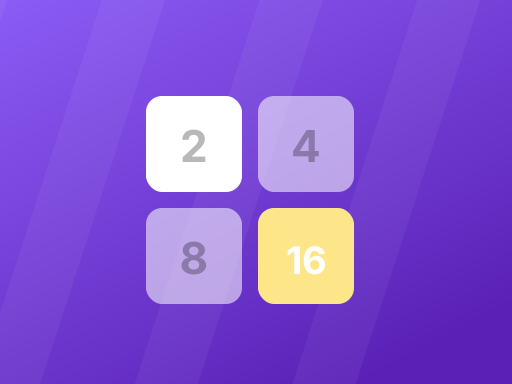
2048 — the one that will eat your afternoon
If you have never played it, 2048 looks trivial. A four-by-four grid, numbered tiles, arrow keys to slide them around. Matching tiles merge and double. Reach 2048 and you win.
The trap is that every move shifts the entire board and drops a new tile, so the grid fills whether you are making progress or not. Within a few minutes you stop thinking about the number you are chasing and start thinking about space — which corner you are protecting, which direction you have quietly stopped being able to press.
Most people lose their first several games in under two minutes and then find they have been playing for an hour. It is the purest example on this list of a game that is easy to learn and genuinely hard to be good at.
Play it if: you like puzzles that punish greed.
HexGL — the one that does not look like a browser game
HexGL is a futuristic anti-gravity racer, and the first time you load it the reaction is usually mild disbelief that it is running in a browser tab at all. Neon canyons, genuine sense of speed, ships that handle with weight.
It descends from the great nineties hover-racers, and it inherits the thing that made those work: the track is not trying to kill you, your own speed is. Braking is admitting something. The air-brake on the shift key is the difference between a clean lap and scraping a wall for six seconds.
Play it if: you want something that looks impressive on a big screen.
Snake Arena — the arena game with no waiting
Most .io-style games need you to find a match, wait in a lobby, and hope the server is not on
another continent. Snake Arena does not, because the other snakes are AI
rather than other people.
That sounds like a downside and mostly is not. You get the thing the genre is actually about — a crowded field where you grow by consuming and die to anything bigger — with no queue and no lag. You refresh and you are back in immediately, which matters in a game where early deaths are normal and cost nothing.
The skill is the same as always: getting long makes you powerful and also enormous and slow, and the winning move is usually to cut in front of someone rather than chase them.
Play it if: you like slither-style games but not waiting for a lobby.
Particle Clicker — the one that teaches you physics by accident
Particle Clicker puts you in charge of a particle physics laboratory. You start by clicking a detector to record collisions one at a time. You end with automated hardware, a research budget and staff.
It was built at a CERN hackathon and it shows, in the good way: the upgrades are real detector components, the research milestones are real discoveries, and by the time you have finished you have absorbed a genuine amount of how particle physics actually works without being taught any of it.
It is also, structurally, a very good clicker. The early game is fast, the mid-game gives you real decisions about where to invest, and it respects your time more than most of the genre.
Play it if: you want an idle game that is not entirely empty calories.
Asteroids — the one that is still perfectly designed
Asteroids is from 1979 and it has not needed changing. You drift around a wrapping screen shooting rocks that split into smaller, faster rocks. Your ship keeps every bit of momentum you give it.
That inertia is the whole game. Stopping is harder than starting, and almost every death comes from drifting into something you cleared thirty seconds earlier and stopped tracking. It is a game about managing a mistake you made four seconds ago.
This version is plain JavaScript with no dependencies, which means it loads instantly and runs on anything.
Play it if: you want to understand why arcade games were designed the way they were.
Classic 8-Ball Pool — the one to play against someone next to you
Most browser pool games have physics that feel like the balls are made of polystyrene. Classic 8-Ball Pool does not. Balls carry spin, collide convincingly, and behave the way you expect off a cushion, which means aiming actually rewards knowing what you are doing.
It plays two-player on one machine, which makes it one of the better options here for handing someone else the mouse.
Play it if: there are two of you and one keyboard.
What makes a browser game good
Having played rather a lot of these, the pattern is fairly consistent. The good ones:
- Start immediately. No menu to read, no tutorial to skip, no settings screen. If a game needs ninety seconds of explanation before anything happens, it has already lost.
- Explain themselves through play. The best of them teach you the rules by letting you fail cheaply, early, and in a way that makes the reason obvious.
- End decisively. A run finishes, you see how you did, and restarting takes one click. Games that make you sit through a defeat animation get closed.
- Respect the tab. They do not autoplay audio, they do not ask for notifications, and they work at whatever window size you happen to have.
Almost every game that has survived in this format for years does all four. It is not a coincidence.