Why Stickman Games Refuse to Die
The crudest art style in browser gaming has outlasted almost every trend around it. Here is what stickman games get right, and which ones are worth your time.
4 min read
A stickman is five lines and a circle. It is the least amount of drawing that still reads as a person. By every rule of how games are supposed to compete, this should have been a dead style twenty years ago — and instead it is one of the most reliable genres on the web.
That is worth explaining, because the reason is not nostalgia.
Cheap to draw, cheap to animate, cheap to break
The practical answer first. A stick figure has no costume, no face, and no proportions to get wrong. That means an animator can pose it in a hundred frames for the effort a single detailed character would cost, and a physics engine can throw it down a staircase without anything looking mangled in the wrong way.
That last part matters more than it sounds. Ragdoll physics — where a character's limbs are simulated rather than animated — looks unsettling on a realistic human and funny on a stick figure. The same tumble that would be gruesome on a detailed model reads as slapstick when the body is six line segments. The art style is not a limitation the developer worked around. It is what licenses the whole genre of physics comedy.
The reading speed problem
Browser games are played in short, interrupted sessions, often on a laptop in a tab that is about to be closed. A game has a few seconds to communicate what is happening.
Detail is the enemy of that. A busy, high-fidelity scene asks your eye to work out what is foreground, what is scenery, and what is about to hit you. A stickman scene has no such ambiguity: the black shape is a person, the other black shape is the other person, and the line between them is the thing that will decide the round.
This is why so many stickman games survive being scaled down to a phone screen with no changes. There is nothing to lose in the scaling.
The genres that actually stuck
Stickman is a look, not a genre, and it has attached itself to four kinds of game that keep working.
Physics and ragdoll. The oldest branch and still the funniest. The goal is usually to launch, drop, or fling a figure and enjoy the result. Precision matters less than the tumble.
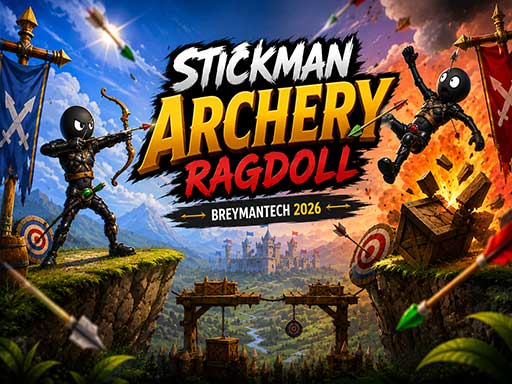
Archery and projectile duels. Aim, judge an arc, release. These are turn-based at heart, which makes them unusually good on touchscreens — you are dragging and releasing, never holding a direction. Stickman Archery Ragdoll is a clean example: the whole game is one gesture, and the ragdoll reaction is the reward.
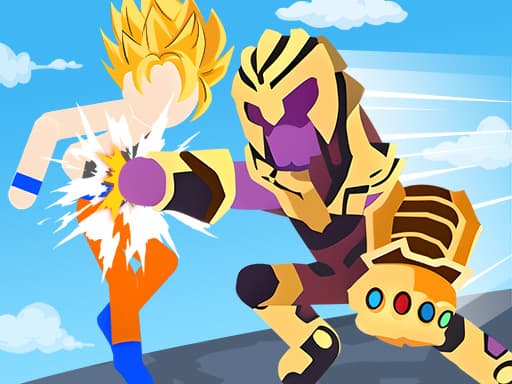
Fighting and beat-em-ups. Combos and juggling read perfectly on stick figures because you can always see every limb. Stickman Warriors Superhero Fight sits here, leaning on the readability rather than fighting it.
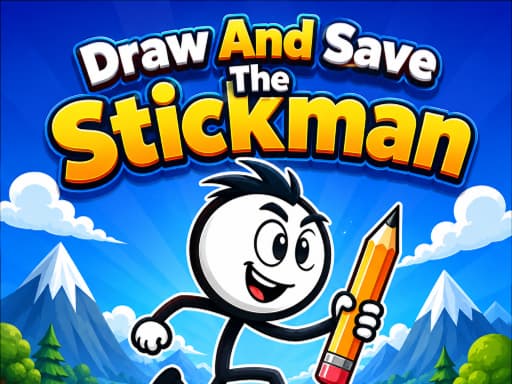
Puzzle and drawing. The newest branch, and the one with the most invention left in it. Instead of controlling the figure, you draw the world around it. Draw and Save the Stickman gives you a line and a problem, and your solution is whatever shape you commit to. It is closer to a physics sandbox than an action game.
What separates a good one from filler
Most stickman games are not good, and the failure modes are consistent enough to spot in the first thirty seconds.
A good one fails fast. If a level takes ten seconds and a mistake costs you three, you will try twenty variations. If a mistake costs you ninety seconds of replay, you will try two and leave. Short loops are the entire genre.
A good one has honest physics. The single most common flaw is a game where the same input produces different results — where the arrow arc is nudged by an invisible random factor to make levels harder. Players cannot articulate this, but they feel it, and they stop playing. If your second identical shot lands somewhere else, the game is cheating.
A good one does not gate the joke. Physics comedy stops being funny when you have to earn it through a currency screen. The tumble should be free and immediate.
The one thing to be skeptical of
Stickman is unowned. No company controls the look, so anything can be called a stickman game, and a large amount of low-effort work uses the style precisely because it is cheap. The style is a signal of nothing at all about quality — it is genuinely just a cost decision by the developer.
The tell is motion. Open one and move. If the figure has weight — if it takes a frame to start and a frame to stop, if a landing compresses before it recovers — someone thought about it. If it slides at a constant speed like a cursor, nobody did, and no amount of levels will fix that.
Where to start
If you have never taken the genre seriously, start with an archery or projectile game rather than a fighter. The loop is shortest, the feedback is clearest, and it works identically on a phone and a laptop. Once the arc calculation stops feeling like guesswork, the physics games open up — and that is the point at which people stop calling it a style for children.