Obby Games: The Genre Roblox Accidentally Invented
Obstacle courses became one of the most played things on the internet without anyone designing the genre on purpose. What makes a good one, and which are worth your time.
4 min read
“Obby” is short for obstacle course, and nobody sat down and designed it. Roblox gave players building tools, some of them built jumping challenges, other players finished them and built harder ones, and within a few years an entire genre existed that no studio had planned.
That origin explains almost everything about how obbies feel — including the parts people complain about.
Why they are built the way they are
A traditional platformer is authored. A designer decides how hard the third jump should be, watches people fail it, and adjusts.
An obby is usually the opposite: built by one person, tested by that person, and published. The difficulty is whatever the builder found satisfying, which is why obbies swing so violently between trivially easy and outright unfair inside a single course. There is no difficulty curve because nobody drew one.
The good ones are the ones where the builder had the patience to iterate — and you can feel that in the first thirty seconds.
What separates a good obby from a bad one
Checkpoint spacing is the whole game. This is the single thing that decides whether an obby is fun or infuriating. A checkpoint every four or five obstacles means a mistake costs you seconds. A checkpoint every twenty means a mistake costs you minutes, and the tenth time you fall at obstacle nineteen you will close the tab and not come back. Difficulty is fine. Repetition as punishment is not.
Honest hitboxes. You should fall because you jumped short, not because your foot clipped a platform edge that looked solid. A well-built obby is slightly more forgiving than it looks; badly built ones are less. If you die twice on a jump you are sure you made, that is the game, not you.
Readable geometry. You need to see where you are going. Obbies that rely on you memorising a blind jump — leaping into off-screen space and hoping — are testing your patience for repetition, not your platforming.
A reason to keep climbing. The best ones change something every stretch: a new mechanic, a visual shift, a moment where you look down and see how far you have come. Twenty identical platforms in a row is a screensaver you can fall off.
The main shapes the genre takes
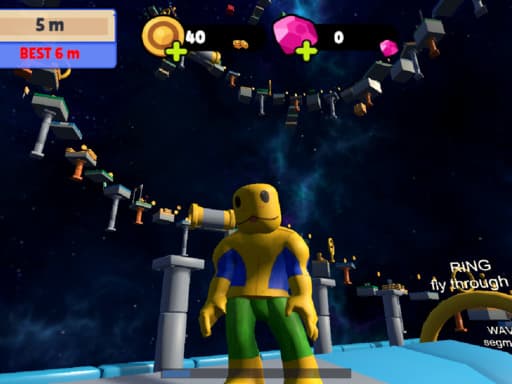
Tower climbs. One vertical structure, and falling costs you real height. Obby Tower: Only Up is the pure version — the punishment for a mistake is watching your own progress rewind past you, which is the tension the whole subgenre is built on. Divisive by design: some people find it thrilling and some find it cruel, and both are reasonable reactions.
Mechanic obbies. One movement idea, explored properly. Obby +1 Double Jump hands you a second jump and then builds everything around what that changes. These tend to be the best-designed obbies, because a single mechanic gives the builder something to iterate on rather than just stacking platforms.
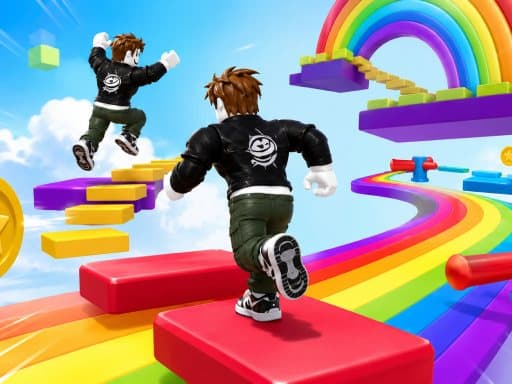
Two-player obbies. Obby Rainbow Parkour Two Player turns it into a race, which fixes the genre's biggest weakness: falling is much less annoying when someone is laughing at you for it. Genuinely the most fun way into obbies if you have someone next to you.
Chase obbies. Something is coming, so you cannot stop and plan. Obby Tsunami Runner removes the option to stand still and study a jump, which turns a platformer into a pressure test. Different skill entirely.
How to actually get better
Three things, in order of how much they help.
Stop jumping at the last moment. The most common beginner mistake is jumping from the very edge of a platform, because it feels like it maximises distance. It does not — you get the same arc, with none of the margin. Jump from slightly back and you will clear the same gaps with room to spare.
Look at the landing, not the gap. Your eyes drag your aim. Watching the space you might fall into makes you more likely to fall into it. Fix on the platform you intend to reach.
Learn the rhythm on moving obstacles rather than reacting to them. Anything on a timer — swinging arms, rising platforms, closing gaps — is a pattern. Stand and watch it cycle twice before committing. Ten seconds of watching beats five failed attempts.
The honest caveat
Obbies are the most uneven genre on any games site, this one included. Because the format is so easy to produce, there are far more mediocre obbies in the world than good ones, and no amount of filtering fully fixes that. The signal is in the first minute: if the checkpoints are close, the hitboxes feel fair and something changes by the second stretch, you are in good hands. If you have died three times to the same blind jump, that is not a challenge you need to rise to. It is just a course someone published without finishing.