Endless Runners: The Genre Built on One Button
Slope, Subway Surfers, Geometry Dash and everything they inspired. Why one-input games are the hardest to design well, and how to tell a fair runner from a cheap one.
5 min read
There is no win condition in an endless runner. You are not going to finish it. The game ends when you make a mistake, and the only question the whole design has to answer is whether that mistake felt like yours.
That single question is why the genre is much harder to build than it looks, and why the handful of runners people still talk about years later are separated from the rest by something quite specific.
The whole genre is a reaction-time contract
Strip a runner down and you have three numbers: how fast the world moves toward you, how far ahead you can see, and how long your input takes to matter.
Divide the second by the first and you get your reaction window — the time between an obstacle becoming visible and it reaching you. A fair runner keeps that window above roughly a quarter of a second at every speed, forever. That is around the limit of human visual reaction, and a game that drops below it has stopped testing skill and started testing luck.
This is the contract. Almost every complaint about a runner being "unfair" is really a complaint that the contract was broken — usually because the difficulty ramp increased scroll speed without also increasing draw distance.
Games that ramp well do one of two things: they widen the camera as speed increases, or they stop increasing speed and start increasing obstacle density instead. Density is the honest difficulty lever, because it never shortens your reaction window — it just gives you more decisions inside it.
Three families, three different skills
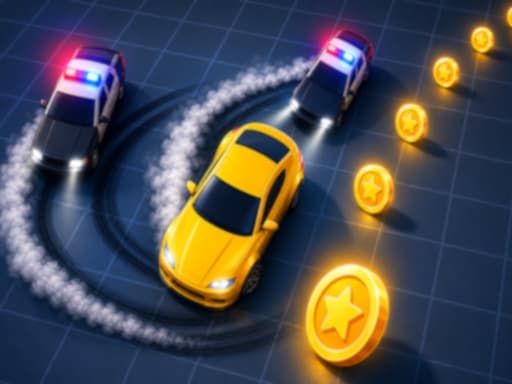
Lane runners. Subway Surfers and its descendants. Three or four fixed lanes, swipe to switch, swipe up to jump. The skill is pattern recognition: you are not aiming, you are reading a shape and picking a lane. These are the most phone-native runners ever made, because a swipe has no precision requirement at all. Police Chase Run sits in this family.
Momentum runners. Slope and everything shaped like it. You steer continuously, and your mistakes compound — a bad correction leaves you with worse position for the next obstacle, not just this one. These are the hardest to play well and the most satisfying to master, because recovery is a real skill rather than a binary.
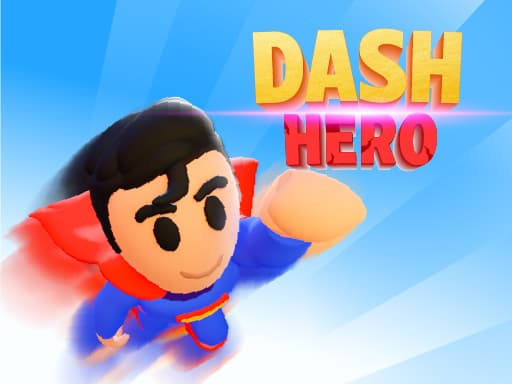
Rhythm runners. Geometry Dash and its imitators. The obstacles are placed on the music, so once you know a section you are performing it rather than reacting to it. This changes the genre completely: memorisation replaces reaction, and difficulty stops being about reflex. Dash Hero leans this way — the early attempts are reading, the later attempts are recall.
The families are not interchangeable. Someone who is excellent at a lane runner may be poor at a momentum one, because reading a fixed pattern and managing continuous drift are unrelated skills.
Why one input is a design constraint, not a shortcut
A runner usually gives you one meaningful action — jump, or switch, or steer. Designers do not do that to be minimal. They do it because the failure has to be unambiguous.
If a game gives you five buttons and you die, you will always suspect the wrong button, the input lag, or the control scheme. If the game gives you one button and you die, there is nowhere to put the blame. That unambiguity is what makes "one more try" work — the genre's entire retention model depends on you believing the last death was yours.
It also means a runner cannot hide a bad feel behind complexity. The single input either responds crisply or it does not, and there is nothing else to look at.
The tells of a bad runner
Obstacles that spawn inside your reaction window. Test it: play badly on purpose at high speed. If things appear already too close to avoid, the ramp is broken.
Randomly generated layouts with no validation. Procedural obstacle placement is fine, but it has to be checked for solvability. Unvalidated generation eventually produces a wall with no gap, and you will lose a good run to it.
Death animations you cannot skip. In a genre built on immediate retry, a three-second crash cinematic is actively hostile. The restart should be instant.
Speed that ramps but never plateaus. Every run ending at roughly the same time regardless of how well you played means the difficulty curve, not you, is deciding the score. Good runners plateau, so that a skilled player's run is genuinely longer.
Getting better at them
The counterintuitive advice, which holds across all three families: look further ahead than feels comfortable. Beginners watch their character. Experienced players watch the far edge of the screen and steer with peripheral vision, because the character's position is something you already know and the incoming layout is not.
The second piece: in momentum runners, correct early and small. The instinct after a near-miss is a hard correction, which overshoots and sets up the next mistake. Two small inputs beat one large one, every time.
And in rhythm runners, stop trying to react. Once a section has killed you three times, you are no longer reacting to it — you are learning it. Play the audio, not the obstacles.
Where the genre is now
Runners largely left the app stores for the browser, and they are better for it. Without an install step there is no reason to pad a session with energy timers or upgrade grinds, and the ones on the web tend to be closer to the arcade original: open, play, die, immediately play again.
That is the version of the genre worth playing. If a browser runner asks you to wait for anything, close it — the whole appeal was that there was nothing between you and the next attempt.